Data story
Northern Ireland is the only UK nation where very low anxiety rose
Data covers 2011–12 to 2022–23
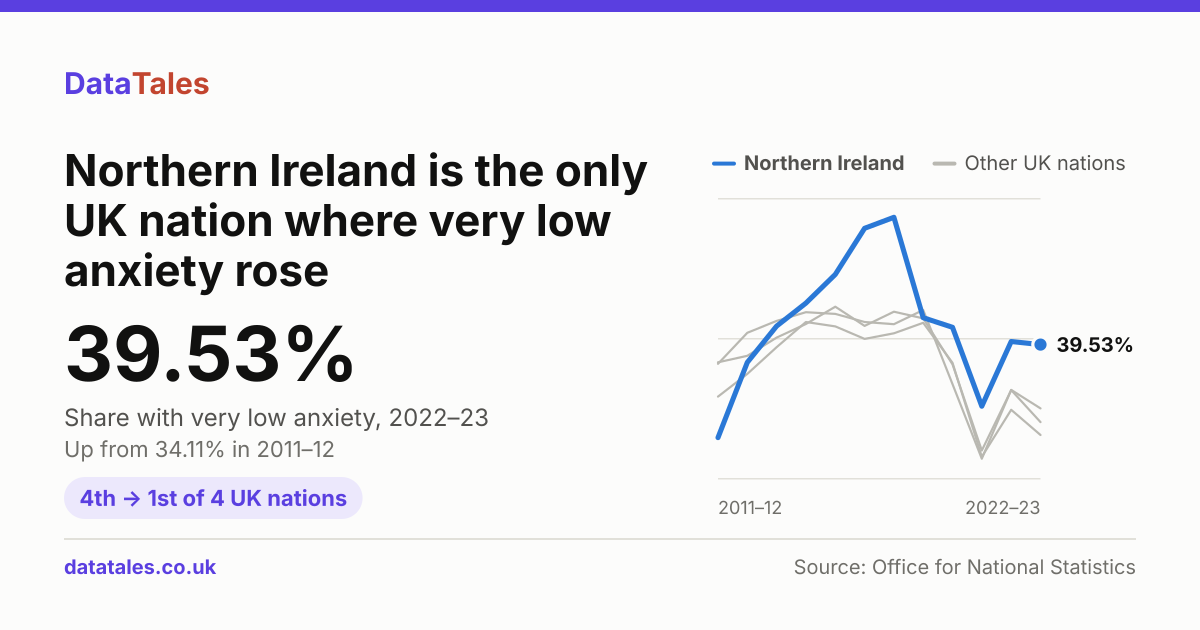
Northern Ireland ranked fourth of the four UK nations for the share of people reporting very low anxiety in 2011–12, but by 2022–23 it had the highest share.
Share of people with very low anxiety, UK nations
% of people
Survey estimates from ONS; annual releases were paused after 2022–23.
Line chart: Share of people with very low anxiety, UK nations (% of people). It shows 4 areas from 2011–12 to 2022–23. Northern Ireland, highlighted, rose from 34.11% in 2011–12 to 39.53% in 2022–23. It peaked at 46.95% in 2017–18. In 2022–23 it was the highest of the 4. It was the only one of the 4 to rise between 2011–12 and 2022–23. Shown in grey: England fell from 36.50% in 2011–12 to 34.26% in 2022–23, Scotland fell from 38.41% in 2011–12 to 35.81% in 2022–23 and Wales fell from 38.50% in 2011–12 to 35.01% in 2022–23.
Who rose and who fell: very low anxiety
% of people
Slope chart: Who rose and who fell: very low anxiety (% of people). It compares 2011–12 with 2022–23 for 4 areas. Northern Ireland, highlighted, rose from 34.11% in 2011–12 to 39.53% in 2022–23. In 2022–23 it was the highest of the 4. It was the only one of the 4 to rise between 2011–12 and 2022–23. Shown in grey: England fell from 36.50% in 2011–12 to 34.26% in 2022–23, Scotland fell from 38.41% in 2011–12 to 35.81% in 2022–23 and Wales fell from 38.50% in 2011–12 to 35.01% in 2022–23.
Share with very low anxiety by nation, 2022–23
% of people
Map: Share with very low anxiety by nation, 2022–23 (% of people). Values range from 34.26% in England to 39.53% in Northern Ireland; a stronger colour means a higher value. England 34.26%, Wales 35.01%, Scotland 35.81% and Northern Ireland 39.53%. Areas without data are grey.
The data
Download CSV| Period | Northern Ireland | England | Scotland | Wales | Northern Ireland 95% CI |
|---|---|---|---|---|---|
| 2011–12 | 34.11 | 36.50 | 38.41 | 38.50 | 31.96 to 36.27 |
| 2012–13 | 38.49 | 37.82 | 40.22 | 38.88 | 36.39 to 40.59 |
| 2013–14 | 40.61 | 39.38 | 40.91 | 39.94 | 38.30 to 42.93 |
| 2014–15 | 41.95 | 40.85 | 41.42 | 40.73 | 39.59 to 44.30 |
| 2015–16 | 43.62 | 40.59 | 41.32 | 41.74 | 41.11 to 46.12 |
| 2016–17 | 46.31 | 39.86 | 40.85 | 40.62 | 44.08 to 48.55 |
| 2017–18 | 46.95 | 40.19 | 40.72 | 41.45 | 44.80 to 49.11 |
| 2018–19 | 41.10 | 40.80 | 41.55 | 41.06 | 39.17 to 43.03 |
| 2019–20 | 40.54 | 38.47 | 37.23 | 38.38 | 38.90 to 42.17 |
| 2020–21 | 35.94 | 32.99 | 32.88 | 33.36 | 33.68 to 38.19 |
| 2021–22 | 39.71 | 35.73 | 36.89 | 36.88 | 37.74 to 41.68 |
| 2022–23 | 39.53 | 34.26 | 35.81 | 35.01 | 37.74 to 41.32 |
95% CI: the range the true value is likely to fall in (95% confidence interval). Values are % of people.
- 39.53%Share with very low anxiety, 2022–23From 34.11% in 2011–12
- 4th → 1stRank among 4 UK nations (1st = highest)Share with very low anxiety, 2011–12 to 2022–23
- 2.91Average anxiety score, 2022–23From 3.15 in 2011–12 (average score out of 10)
- 7.93Average worthwhile score, 2022–23From 7.76 in 2011–12 (average score out of 10)
Northern Ireland is the only UK nation where the share of people reporting very low anxiety rose between 2011–12 and 2022–23. According to the Office for National Statistics’ Personal well-being estimates by local authority, 34.11% of people in Northern Ireland rated their anxiety as very low in 2011–12. By 2022–23 that had risen to 39.53%, an increase of 5.42 percentage points. Because a lower anxiety level is better, this is good news. The data covers every financial year from 2011–12 to 2022–23.
The path was not smooth. The share climbed in the early years, including a rise of 4.38 percentage points to 38.49% in 2012–13, and reached a peak of 46.95% in 2017–18. It then fell by 5.85 percentage points to 41.10% in 2018–19. In 2020–21 it dipped again, by 4.60 percentage points to 35.94%, before recovering to 39.71% in 2021–22. The latest value of 39.53% is well below the 2017–18 peak of 46.95%, a gap of 7.42 percentage points. The 2020–21 drop was not unique to Northern Ireland: the share with very low anxiety fell in all four nations that year.
How it compares
In 2011–12 Northern Ireland ranked fourth of the four nations on this measure. Wales stood at 38.50%, Scotland at 38.41% and England at 36.50%. By 2022–23 Northern Ireland had the highest share at 39.53%, clearly above Scotland at 35.81%, Wales at 35.01% and England at 34.26%. That is a climb of three places, from fourth to first. Northern Ireland’s rise of 5.42 percentage points was the biggest change of the four nations and the only rise; in the other three nations the share fell.
Other well-being measures for Northern Ireland point in a similar direction. Average anxiety, scored out of 10 where lower is better, fell from 3.15 in 2011–12 to 2.91 in 2022–23, a fall of 0.24. It reached a low of 2.53 in 2017–18, rose by 0.30 to 2.83 the following year, and stood at 3.11 in 2020–21 before easing to 2.84 in 2021–22. Average ratings of how worthwhile people feel their lives are rose by 0.17, from 7.76 to 7.93, and average happiness rose by 0.18, from 7.39 to 7.57. Both dipped in 2020–21: worthwhile ratings fell from 8.06 to 7.90 and happiness from 7.67 to 7.49.
What the data can’t tell us
These figures are survey estimates from the Annual Population Survey, and each comes with a confidence interval. Northern Ireland’s intervals are wider than England’s: in 2022–23 its estimate of 39.53% had a range of 37.74% to 41.32%, compared with 33.70% to 34.81% for England. Small differences between years or places may not be real differences, although the changes described here are statistically clear.
The survey records how people rated their own well-being. It does not explain why scores changed, so the data cannot say what lies behind Northern Ireland’s rise or the dip in 2020–21.
ONS paused its annual personal well-being estimates after the April 2022 to March 2023 period because of falling response rates and weighting problems in the Annual Population Survey, so 2022–23 is the latest year available. Since October 2024, ONS has classed these estimates as official statistics in development rather than accredited official statistics, so they should be read with some care.